‘I am mother, leader, warrior of the Amazon’: Nemonte Nenquimo on why the west needs to be rescued
The Waorani leader says millennia of living in harmony with their surroundings give Indigenous groups unique insights into the consumerist west
- •Nemonte Nenquimo's activism is driven by her personal experience of being exploited by Western influence, leading her to fight for Indigenous rights in the Amazon.
- •Nenquimo's leadership has been recognized globally, but she faces fierce opposition from those seeking to exploit the Amazon's resources, including violence from drug gangs and illegal miners.
- •The Ceibo Alliance's efforts to protect the Amazon's lands and cultures are not only about land protection, but also about preserving the rich linguistic, cultural, and spiritual traditions of the forest peoples.
Every Waorani child knows the story of the boa's mouth. How the snake inches forward, watching, its movements almost imperceptible, before it strikes, swallowing its victim whole.
Nemonte Nenquimo knows the boa's bite. Beguiled as a young girl by the blue eyes and bright dresses of an American missionary child in her Amazon village in Ecuador, she consented to be baptised and left home to study at a church school.
"My grandfather used to tell me that the global system of money and material things is like the boa. It attracts people, it bewitches," the 41-year-old Indigenous activist says. "It's a fact, I've lived it."
The Nenquimo of today has travelled far from her teenage self. Feted by Time magazine as one of the world's 100 most influential people, this vocal activist for Indigenous rights proudly identifies as a "mother, leader, and warrior of the Amazon".
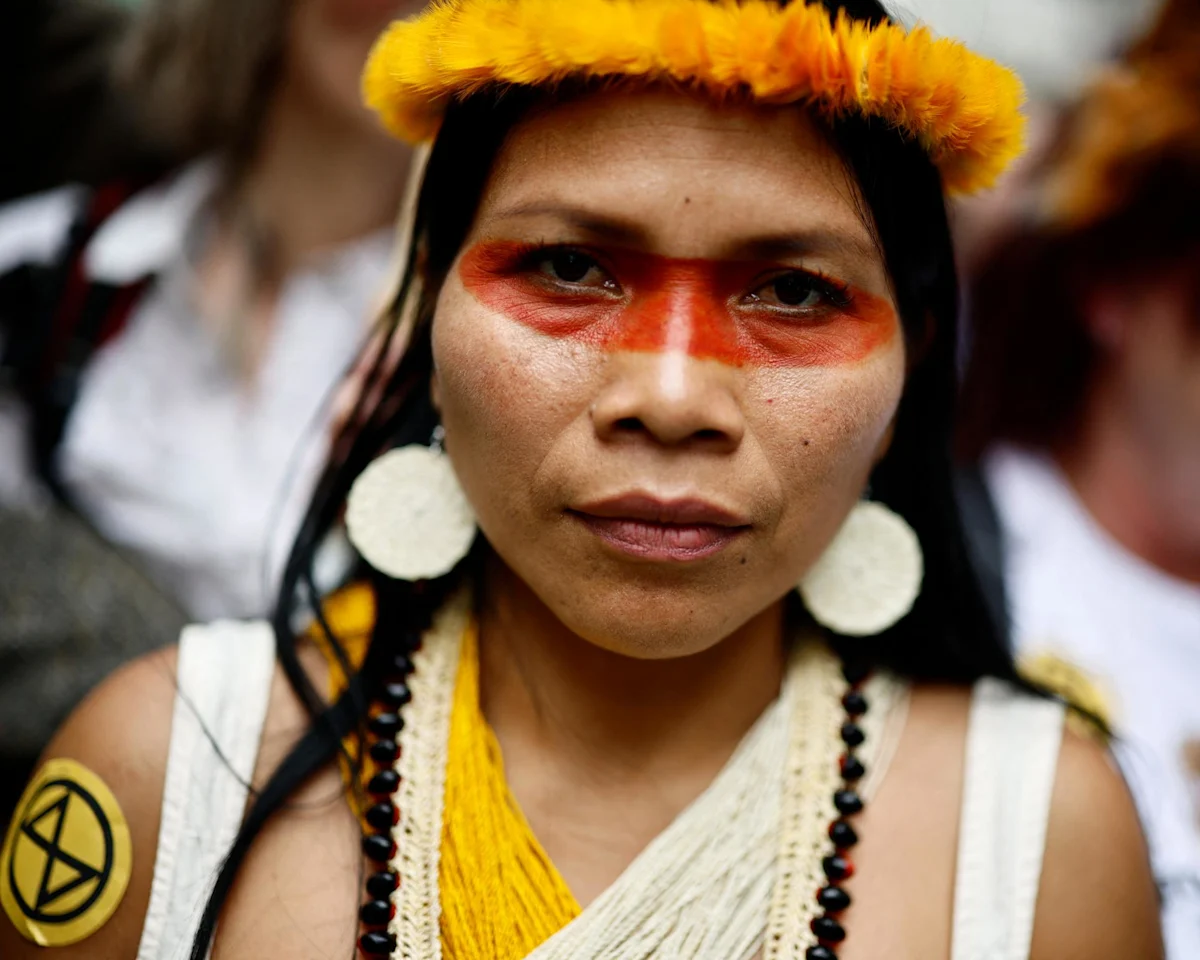
Dressed in ceremonial dress, her eyes masked behind an achiote-seed red dye and with a sacred palm-fibre band around her head, she was in Europe in September to collect the €1m Gulbenkian prize for humanity.
The prize recognises her leadership of the Ceibo Alliance, a coalition of four forest peoples spanning Ecuador, Peru and Colombia that she helped co-found back in 2014 and that fights to defend Amazonian lands and cultures.
Born into a Waorani community in the southern Ecuadorian Amazon, Nenquimo first grabbed international headlines when she issued an open letter to global leaders in which, among other stinging truths, she denounced the "white man that knows too little for the power that he wields".
The viral letter was prompted by the Covid-19 pandemic, which claimed the lives of thousands of forest peoples across the Amazon, including that of the prominent Kayapó chief Paulinho Paiakan.
"The outside world comes with beautiful words, 'We save, we bring a project of salvation', [but] you're not saving; you're really killing my people, my ancestors, my territory," she says.
Through the Ceibo Alliance, Nenquimo has done much to resist the outside world's encroachment. The "pillaging" of the Amazon rainforest, a magnet for loggers, oil companies, cattle ranchers and goldminers over recent decades. Years ago, she spearheaded a successful legal case against the Ecuadorian government's decision to license a 202,000-hectare (500,000-acre) plot of Waorani historic lands for oil exploration.
Other tactics deployed by the alliance include an "Indigenous guard" system, where volunteer patrols use drones, camera traps and other monitoring equipment to track illegal incursions into their land.
But opposition is fierce. Last year, following a nationwide protest organised by Ecuador's main Indigenous group (Conaie), the Ceibo Alliance had its bank accounts frozen without warning.
Violence from drug gangs and illegal miners is also spilling over into Indigenous territories, Nenquimo warns. In neighbouring Colombia, for example – which includes territories of two of the Alliance's people groups, the A'i Cofán and Siona – 39 land activists were murdered last year, almost one-third of all such killings globally.
Her fight extends beyond land protection. The incursion of cowori (the Waorani word for "white man") is also undermining the rich linguistic, cultural and spiritual traditions of the forest peoples, she argues.
"Through their 'salvation', they make us disconnect from our own connection with the plants, with the spirit of the jaguar, with healing," she says. "The Waorani people have even begun to stop taking ayahuasca, which is a sacred medicine for all Amazonian peoples."
Yet, Nenquimo vehemently rejects any narrative of victimhood. She says that it's the west that really needs rescuing. Moreover, the rainforest defender believes people groups like hers have answers to hand.
First, the west has an imperative to reconnect with Mother Earth. The forest, as Nenquimo is fond of saying, is her community's "market, pharmacy, hardware store and place of worship". To destroy it, therefore, is to jeopardise their survival.
"We are not destroyers. We do not pollute the river. Gold is what we have to leave. Petroleum is the blood of our ancestors," she says. "The water you drink, the air you breathe – as Indigenous peoples, we are protecting it."
Connecting with nature extends to connecting with those who inhabit and guard it, she adds. Millennia of living in harmony with their surroundings give Indigenous groups unique insights that the consumerist west would gain by rediscovering them. Hence her antipathy to international charities and other well-meaning groups that impose sustainability solutions born of their own market mentality, such as carbon credit schemes and "sustainable" commercial agriculture.
In her recent memoir, We Will Not Be Saved, Nenquimo goes further, arguing that "connectedness involves responsibilities"; not least for those in industrial economies to beware the boa and question their pursuit of relentless economic growth.
Learning to overcome the barriers that divide us is also critical, she maintains. As a union of distinct peoples with a history of inter-tribal conflict, the Ceibo Alliance demonstrates in microcosm what is possible when old enmities are left behind.
That journey begins with empathy, she says. In her memoir, she recalls realising that for the judges in her landmark court case to "truly see" her, she must also see them: "Not as enemies … not as caricatures of conquest but rather as people."
Last, and arguably hardest, is finding the humility to genuinely listen and the strength to truly love. This Waorani leader has every reason to hate the cowori: under their hand, disease, pollution, deforestation and, in her own lived experience, sexual abuse have been inflicted upon her people.
If the world's "developed" countries are to be saved – from the desire to take, to own, to control – then acknowledging that the planet's last remaining "primitive" peoples might have something valuable to impart merits consideration, she suggests.
"If you don't have a mind or heart to love, then what's the point? It's just being angry, wanting to devour, wanting to accumulate," she says. "When we die, we will go with a light, peaceful spirit. We won't have to suffer in our spirit."
About The Guardian (via Newsroom Daily Wire)
Dispatches and breaking reports syndicated from The Guardian via the UK Wire Service.
Letters to the Editor & Reader Submissions
To preserve journalistic integrity and protect against automated web spam and unsolicited commercial backlink placement, open public commenting threads are closed.
We welcome thoughtful, verified commentary. Letters intended for publication on our editorial ledger must include your full name, city/country, and professional or institutional affiliation.
More in World News

Private school charging up to £14,990 per term announces sudden closure during October holidays
Body of missing California hiker recovered on Mount Whitney